
Two Maps, Same Mountain: What the Elements Keep Telling Us
Four elements that describe the textures of experience. And one that describes what experience is happening in.

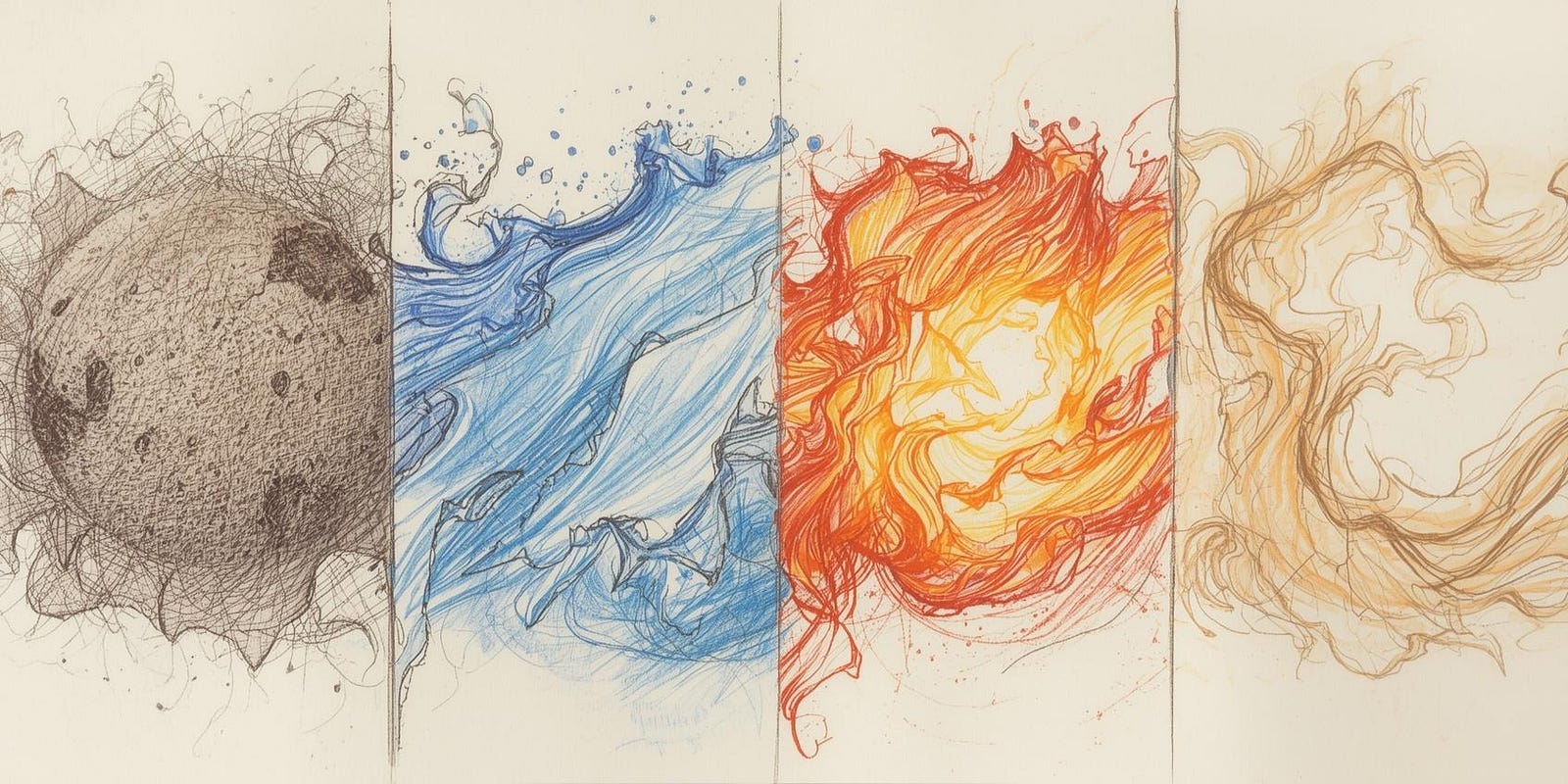
I’ve been watching Memoirs of a Geisha and the characters keep talking about elements. Sayuri is water. Someone else is wood. There’s this whole way of reading a person through what element they are, and it stopped me. Because I’ve heard this language before, just from a completely different direction.
In yoga, the elements are everywhere. Earth, water, fire, air, space. They show up in how you eat, how you breathe, how you move on the mat, what time of day you wake up. I’d been swimming in this for a while without quite noticing I was swimming.
And then this Japanese film starts using almost the same vocabulary, and I went looking.
The strange thing I found
It turns out it’s the same system. Or rather, it was the same system, once. The Japanese version — Godai, “five greats” — traveled from India through China to Japan, carried by monks in the early 9th century. They brought back Buddhist teachings that had Indian roots, and those roots had the same five elements that were already at the heart of yoga and Ayurveda.
So when Sayuri is called water, and a yoga teacher tells you your dosha has too much fire, they’re working with cousins. Distant cousins now, shaped by very different cultures, but cousins.
I find this kind of thing wildly interesting. The way an idea can travel three thousand miles and a thousand years and still be recognizable when it arrives.
What the two maps share
Earth is earth in both. Solid, dense, stable, the part of you that resists change, the part of the world you can stand on. The bones, the stones, the patience. Both traditions say if you’re feeling unmoored, get into your body, eat something heavier, walk on the ground.
Water is water. Fluid, adaptive, taking the shape of whatever holds it. The blood, the tears, the rivers. Both traditions say water is what teaches you how to be flexible without losing yourself.
Fire is fire. Transformation, digestion, passion, the thing that turns one form into another. Both traditions say too much of it burns you down, too little leaves you cold and undigested.
Air — Vayu in Sanskrit, Fū in Japanese — is movement, breath, the wind that carries seeds and ideas. Both traditions say it’s what keeps you from getting stuck.
So far the maps overlap almost perfectly.
And then there’s the fifth
In yoga the fifth element is Akasha. Space, ether. The openness in which everything else can exist. Without space there’s nowhere for earth to settle, nowhere for water to flow, nowhere for fire to burn, nowhere for air to move. Akasha is still kind of a thing in this system — a subtle thing, but a thing. It’s the medium of sound, the cavities in your body, the room your organs need to do their work.
In Japanese Buddhism the fifth element is Kū. Usually translated as void, sometimes as sky, sometimes as emptiness. Kū isn’t really an element among five. It’s more like… what the other four arise in. The silence the bell rings into. The page the painting is on. The pause that makes the music music.
You can feel the Buddhist influence here. Centuries of meditation on śūnyatā — emptiness — have done something to this fifth element. It’s no longer just space-as-medium. It’s become space-as-awareness. The thing that’s always present, never an object, never something you can grab, but somehow the most fundamental thing of all.
This might be my favorite divergence between the two systems. Yoga keeps the fifth element grounded, almost physical. Japanese Buddhism lets it dissolve into something stranger and wider.
What the maps are for
Different cultures did different things with the elements.
India built medicine. Ayurveda took the five elements and combined them into three doshas — Vata, Pitta, Kapha — and built a complete system of health around them. Diet, herbs, daily rhythms, what to do in summer, what to do when you can’t sleep. The elements became a way of taking care of the body and mind across a lifetime.
Japan built aesthetics. The elements show up in pagodas (each tier is one), in stone lanterns, in rock gardens, in tea rooms, in swordsmanship. Miyamoto Musashi structured his whole book on swordsmanship around them — earth as foundation, water as adaptability, fire as combat, wind as studying your opponent, void as the place beyond technique.
One culture said: use the elements to live well in your body.
The other said: use the elements to see beauty, to fight well, to arrange a room, to know when to be silent.
Same five threads, different fabric.
Where it gets personal
What I keep coming back to is how useful this is as a way of noticing what’s happening in me on any given day.
Some mornings I wake up and there’s too much air. Mind racing, can’t sit still, ten ideas, no roots. The system tells me: ground. Slow down. Eat something heavy. Put your hand on stone.
Some days it’s all earth. Heavy, stuck, can’t move. The system tells me: bring fire. Move the body. Eat something with spice. Light a candle.
Some days everything is fire and I’m burning my own house down. The system tells me: cool. Drink water. Sit by something flowing.
I love that these aren’t moral categories. There’s nothing wrong with being more water, or more fire, or having a day where one element runs the show. The traditions are just teaching you to read the weather inside yourself, and to know what its opposite looks like so you can find balance.
And underneath all of it, the fifth element. Akasha. Kū. The space in which the weather happens. The thing that doesn’t get blown around by the wind because it is the wind’s possibility.
When I sit quietly and feel the weight of my body — that’s earth. The wetness of breath, the saliva, the tears just behind the eyes — that’s water. The warmth of being alive, the metabolism running — that’s fire. The breath moving in and out — that’s air.
And the knowing of all of it? The aware presence in which earth and water and fire and air all show up?
That’s the fifth.
That’s what both traditions, in their different languages, keep pointing at.
I don’t think the elements are literal. I don’t think there’s a fire-substance in me distinct from a water-substance. The traditions weren’t doing chemistry. They were doing something more like… developing a vocabulary precise enough to describe what it actually feels like to be alive in a body that contains weather.
And I think they were doing one more thing. They were leaving you a doorway. Four elements that describe the textures of experience. And one that describes what experience is happening in.
You can use the first four for the rest of your life and find them endlessly useful.
But the fifth is sitting there. Quiet. Pointing somewhere.
Maybe that’s the whole point of the elements, really — they give you a complete map of the manifest world, and then they whisper that there’s something the manifest world is appearing in, and they don’t insist you go look. They just leave the door open.
Whether you walk through it is up to you.
This was such a beautiful example of comparative philosophy made deeply personal and accessible. I love how the piece bridges entire spiritual traditions without flattening their differences. You treat both systems with real nuance and respect while still making the ideas feel emotionally immediate and relevant to ordinary life. You also do a wonderful job showing how wisdom traditions separated by geography and centuries can still arrive at strikingly similar insights about embodiment, balance, awareness, and what it means to be human. Really stunning piece! Thank you for sharing!
This was very beautiful Oguz! Different ways of expressing the same things in different cultures is so well defined here. I love all those ways. Thanks for sharing!